
 Pesa Sahihi
Reference · kept current with the statutes
Kenyan payroll tax rates, 2026.
The four statutory deductions, on the table in force now and the one before it. These are not transcribed from a circular — they are the exact figures our payroll engine computes with, printed by the same code. When a new table lands in the engine, this page moves with it.
The February seam
Tables take effect in February, not January. January 2026 was still on the February 2025 table; the NSSF Tier II ceiling moved from 72,000 to 108,000 when the February 2026 table took over. No payslip says which table it used — Pesa Sahihi reads the month.
PAYE bands — Kenya’s income tax bands
Monthly taxable pay — gross less NSSF, SHIF and the Housing Levy. Personal relief comes off the computed tax.
February 2025 table
In force 1 February 2025 to 31 January 2026 · superseded
| The first 24,000 | 10% |
|---|---|
| The next 8,333, to 32,333 | 25% |
| The next 467,667, to 500,000 | 30% |
| The next 300,000, to 800,000 | 32.5% |
| Everything above 800,000 | 35% |
| Personal relief (monthly) | 2,400 |
February 2026 table
In force now · from 1 February 2026
| The first 24,000 | 10% |
|---|---|
| The next 8,333, to 32,333 | 25% |
| The next 467,667, to 500,000 | 30% |
| The next 300,000, to 800,000 | 32.5% |
| Everything above 800,000 | 35% |
| Personal relief (monthly) | 2,400 |
NSSF
Two tiers, employee share shown; the employer matches it shilling for shilling.
February 2025 table
In force 1 February 2025 to 31 January 2026 · superseded
| Tier I — 6% of pay up to 8,000 | at most 480 |
|---|---|
| Tier II — 6% of pay between 8,000 and 72,000 | at most 3,840.00 |
| Employer matches | same again |
February 2026 table
In force now · from 1 February 2026
| Tier I — 6% of pay up to 9,000 | at most 540 |
|---|---|
| Tier II — 6% of pay between 9,000 and 108,000 | at most 5,940.00 |
| Employer matches | same again |
SHIF and the Affordable Housing Levy
SHIF is charged on gross pay and floored at a monthly minimum. The Housing Levy is charged on cash pay and the employer matches it.
February 2025 table
In force 1 February 2025 to 31 January 2026 · superseded
| SHIF — 2.75% of gross | 2.75% |
|---|---|
| SHIF minimum — below about 10,910 of gross this is what applies | 300 |
| Affordable Housing Levy — of gross, employer matches | 1.5% |
February 2026 table
In force now · from 1 February 2026
| SHIF — 2.75% of gross | 2.75% |
|---|---|
| SHIF minimum — below about 10,910 of gross this is what applies | 300 |
| Affordable Housing Levy — of gross, employer matches | 1.5% |
A detail worth knowing, because the Act itself does not settle it: the Affordable Housing Act 2024 charges 1.5% of “gross monthly salary” and defines neither that phrase nor “employee”. The definition everyone works to is KRA’s — basic salary plus regular cash allowances, with non-cash benefits and irregular payments outside the base. We compute it that way, so a car or phone benefit raises PAYE but not the levy.
The wording comes from KRA’s 15 August 2023 notice, issued under the earlier Finance Act 2023 levy that the 2024 Act replaced. No notice under the current Act restates it, which is why this is the settled reading rather than a quotable rule, and why we say so rather than implying otherwise.
Reliefs and limits
From the Tax Laws (Amendment) Act 2024, effective 27 December 2024. Rows appear here as each figure is confirmed — never before.
Reliefs and deductions
Checked against the consolidated statutes on 13 August 2026
| Mortgage interest360,000 a year, raised from 300,000 on 27 December 2024. The Finance Act 2025 added construction to purchase and improvement, from 1 July 2025. The lender must be a financial institution named in the Fourth Schedule, it covers one residence, and a part year is prorated. A deduction: it comes off before the bands. | 30,000 a month |
|---|---|
| Insurance premiums60,000 a year. Life policies on yourself, your spouse or your child, education policies with a term of at least ten years, and health policies. A relief, not a deduction: it is set off against the tax after the bands have been charged. NHIF relief ended with NHIF; SHIF carries no relief and is a deduction instead (ITA s.15(2)(ae)). | 15% of premiums, capped 5,000 a month |
| Post-retirement medical fund180,000 a year, from 27 December 2024 (ITA s.15(2)(ad)). A deduction, before the bands. The old post-retirement medical relief was deleted the same day. | 15,000 a month |
| Pension contributions360,000 a year, from 27 December 2024 (ITA s.22A). NSSF counts INSIDE this cap, not on top of it — s.22A(8) deems NSSF contributions to be contributions to a registered fund. The deduction is the lesser of the contributions made, 30% of pensionable pay and this figure; anything above it is still deducted from pay, it simply stops reducing the tax. | 30,000 a month |
| Non-cash benefitsThe threshold in ITA s.5(2)(b), raised from 36,000 a year on 27 December 2024. The Act states the annual figure; the monthly equivalent is KRA’s. Housing, car and low-interest-loan benefits have their own valuation rules and are outside this. | 60,000 a year (5,000 a month) |
Employer-provided housing
Income Tax Act s.5(3) · four categories, not the two most summaries print
| Director, not in whole-time service15% of total income, the fair market rental value, or the rent the employer pays. | The highest of three |
|---|---|
| Whole-time service director15% of employment income, the fair market rental value, or the rent paid. | The highest of three |
| Agricultural employee required to live on the farmKRA requires prior approval from the domestic taxes office, and utilities are rated lower. | 10% of employment income |
| Any other employeeThe rent counts only where the employer rents at arm’s length from a third party. Premises the employer owns are valued at the fair market rental value. Where the rent is not at arm’s length, the higher of that value and the rent paid. | 15% of employment income, or the rent, whichever is higher |
| Where employment income excluding housing exceeds 600,000 a yearProviso (iv) to s.5(3) — omitted by almost every summary, including KRA’s own guide example. | capped at market rent |
Withholding tax on interest
Third Schedule Head B · for a resident individual; a company is taxed differently
| Treasury billsThird Schedule Head B para 5(h)(iii). | 15%, final |
|---|---|
| Treasury bonds under 10 yearsThird Schedule Head B para 5(h)(iii). | 15%, final |
| Treasury bonds of 10 years or moreThe lower rate comes through Third Schedule Head B para 5(b)(iii). | 10%, final |
| Infrastructure bondsFirst Schedule para 51, for a term of three years or more. A 5% rate was proposed in the Tax Laws (Amendment) Bill 2024 and dropped before enactment. | Exempt |
| Commercial paperInterest and the discount are both qualifying interest (ITA s.2, widened to cover commercial paper in 2020); the rate is Third Schedule Head B para 5(h)(iii). This is registered, dematerialised paper — an ordinary Capital Markets Authority programme. A resident company pays the same 15%, but for a company it is a credit rather than final. | 15%, final |
| Bearer instrumentsThird Schedule Head B para 5(h)(ii), for an individual. The 25% that gets quoted is para 5(b)(i), which is bearer interest paid to residents who are not individuals. | 20%, final |
Check a real number against these
Rates are one thing; a payslip is another. Put a salary through the net pay calculator or the PAYE calculator and watch these exact figures at work, in the order the law applies them.
What this page does not list yet
Mortgage-interest, insurance-relief and post-retirement-medical limits, and employer housing valuations, are still going through confirmation and will join this page when they clear. We print figures our engine computes with or figures with a receipt — never a maybe.
Take the card
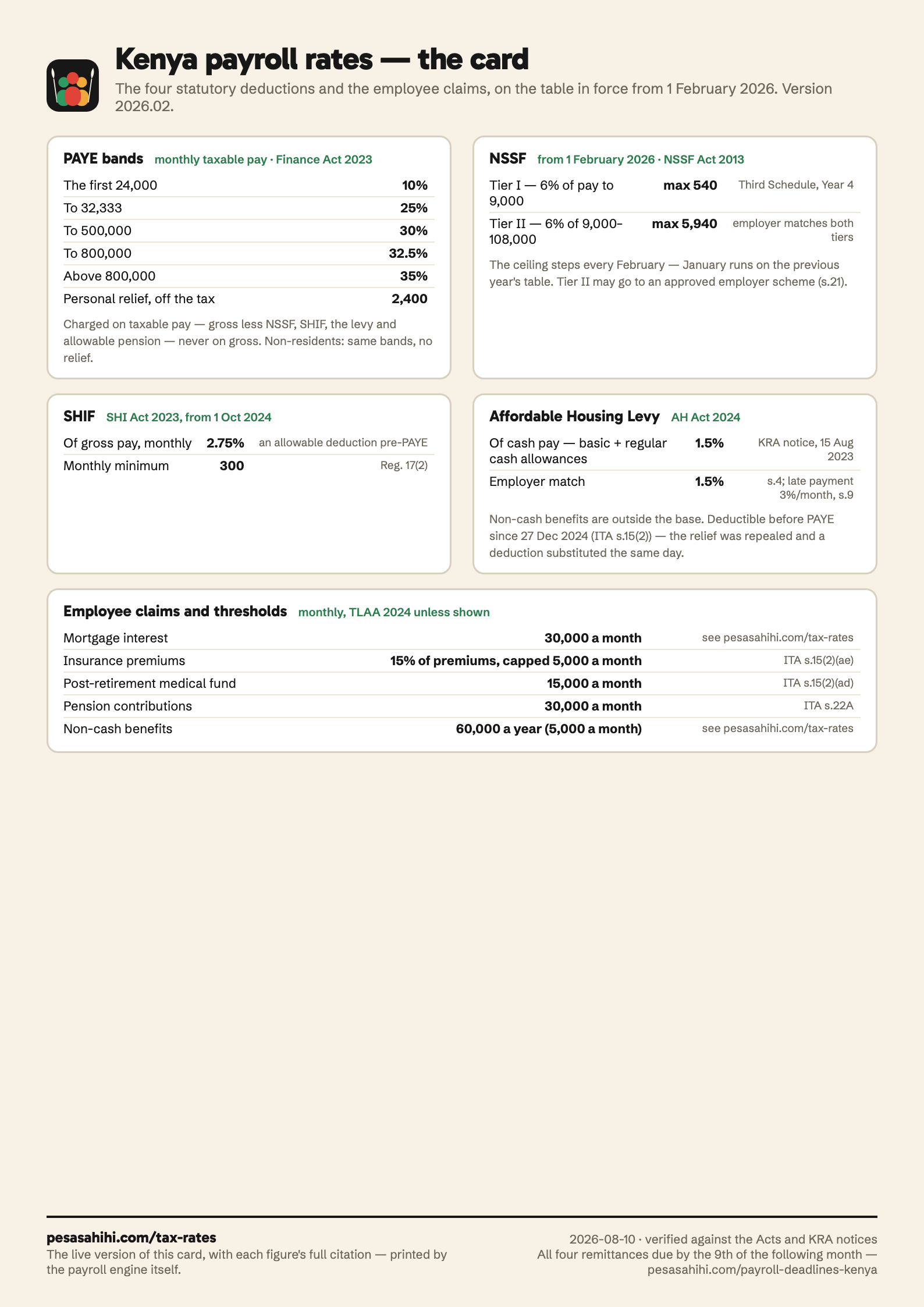
This page as one printable A4: the rates card (PDF) or as an image — every figure with its statute, versioned to the table in force, for the noticeboard or the WhatsApp group. Re-issued each February when the table steps.
How the deductions fit together
These are the figures. The order they come off in — NSSF, SHIF and the Housing Levy off gross to reach taxable pay, then PAYE on the remainder, then personal relief off the tax — is set out on statutory deductions in Kenya, along with why the levy still reduces taxable pay.
Sources
KRA public notice on Housing Levy collection · KPMG analysis of the Tax Laws (Amendment) Act 2024 · RBA on the pension amendments. The statutory tables themselves are printed by the same engine that writes the app’s payslips — an engine whose KRA PAYE exports have come out byte-identical to real iTax submissions in parallel runs. The full sourcing hierarchy, and what we do when the law is silent, is on the methodology page.
What are the PAYE rates in Kenya?
PAYE is charged in five progressive bands on taxable pay, with a flat personal relief taken off the tax that results. The bands, their widths and the relief are in the PAYE table above, printed from the same engine that computes the payslips — along with the table in force before this one, because January payroll is computed on that one.
What are the income tax bands in Kenya?
The same table. “PAYE”, “income tax” and “tax brackets” all name the charge in the bands above — PAYE is the mechanism by which an employer deducts income tax from employment income and remits it, not a separate tax. What makes the Kenyan version different from a simple bracket lookup is the base: the bands are applied to pay after NSSF, SHIF and the Housing Levy, not to gross.
Is PAYE charged on gross pay?
No. NSSF, SHIF and the Affordable Housing Levy are deducted first, and PAYE is charged on the balance — taxable pay. Personal relief then comes off the tax, not off the income. The order is set out on statutory deductions in Kenya.
What percentage of a Kenyan salary goes to tax and deductions?
There is no single percentage, and any page that prints one is guessing. Four charges apply at once: SHIF and the Housing Levy are flat percentages of gross, NSSF is two tiers with a floor and a ceiling so it stops rising past a point, and PAYE is progressive so it keeps rising. The effect is that the total share climbs with salary and no formula covers it — put a real figure through the net pay calculator and the deductions are itemised against it.
When do Kenyan payroll tax rates change?
In February, not January. The NSSF Act 2013 phase-in lifts the Tier II ceiling every February, so January is computed on the previous year’s table and the eleven months after it are not. A tax year is not a calendar year. Every dated change is listed on the rates changelog.
How is a second job or a secondary employer taxed in Kenya?
As one taxpayer, not two. Each employer running its own payroll gives the employee the progressive bands twice and personal relief twice, which under-deducts — the shortfall lands on the employee at assessment. Charged correctly, the second employment’s taxable pay is stacked on the first so the higher bands apply and relief is claimed once. Matching is on the KRA PIN.
Is the Housing Levy charged on non-cash benefits?
The Affordable Housing Act 2024 charges its rate on “gross monthly salary” and defines neither that phrase nor “employee”. The definition everyone works to is KRA’s — basic salary plus regular cash allowances, with non-cash benefits and irregular payments outside the base. We compute it that way, so a car or phone benefit raises PAYE but not the levy. The reasoning, and what we do where the law is silent, is on the housing levy calculator.
Does the employer match NSSF and the Housing Levy?
Yes to both. NSSF is two tiers, and the employer matches the employee share shilling for shilling. The Housing Levy is charged on cash pay and the employer matches it too — so the cost to the business is twice what the payslip shows on those two lines.
Is there a minimum SHIF contribution?
Yes. SHIF is charged on gross pay and floored at a monthly minimum, so a low salary pays the floor rather than the percentage. Both the rate and the floor are in the SHIF table above.
Statutory positions on this page last verified against the Acts and KRA notices on 10 August 2026, by XELQ Ltd. Rates themselves are printed by the payroll engine, so they move with it.